
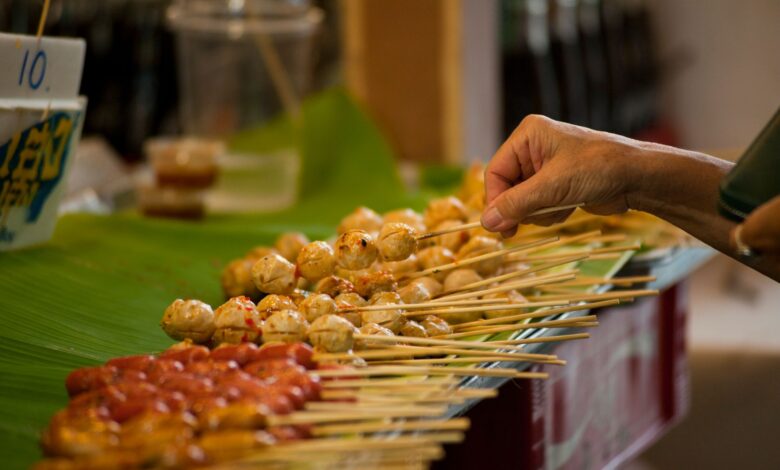
Street food in Bangkok is cheap, fast and mostly very good, and picking something to eat turns out to be the easy part. The parts that catch people out are smaller than that: sizing up a stall in a few seconds, and being able to pay for what you order. Those are the two places where ordinary advice runs out — public-health guidance and traveller advice point at different risks, and almost nothing tells you what a stall will take as payment.
The honest version of the famous queue rule is that it is real and partial. A busy stall is turning its stock over quickly, which is a genuine freshness signal. It says nothing about the water the plates were rinsed in, and that is the specific risk the US Centers for Disease Control and Prevention names for Thailand in its Yellow Book chapter, reviewed on 23 April 2025. Both problems trace back to one fact about how a Bangkok food stall is built.
Bangkok street food: why the city eats on the street (and why that changes your order)
Stand on almost any busy soi at seven in the evening and you will notice something before you notice the smell: nearly every cart is selling one thing. Not a menu. One dish, made by people who have made only that dish for years.
That is not a tourist-street quirk, it is the shape of the market. Street food was the single largest contributor to the value of Thailand’s entire eating-out sector in 2025, ahead of restaurants and ahead of the fast-food chains, generating over 332.1 billion baht on research by Deloitte published by Thailand’s Government Public Relations Department in June 2026. A 2026 open-access study in the International Journal of Environmental Health Research makes the same point structurally: street stalls and kiosks account for around 65% of all foodservice outlets in Thailand, against roughly 35% for restaurants, cafés and bars, on figures the authors draw from United States Department of Agriculture data.
Every figure and rule in this guide was checked on 20 September 2026, and prices, opening hours and Thai food-hygiene schemes are set by the businesses and the authorities that run them and can change without notice, so confirm anything you plan to rely on with the stall or the issuing authority before you travel.
Once the market shape lands, the stall stops looking like a snack cart. It is a small business whose entire economics rest on a single recipe: the owner buys stock for that dish, owns the pan for that dish, and sells to regulars who would notice the same week if it changed. Three things you will meet on your first evening follow from that, and none of them is a sign of anything being wrong.
- The menu is short or absent, because there is no range to browse — you pick the stall first, then the size.
- The stall trades in a narrow window and shuts when the pot is empty, because a day’s stock is bought for a day’s trade.
- Prices sit close together within a dish family, because dozens of vendors within walking distance sell the same thing to the same customers.
That last one is the useful one, and it is why the money section later in this guide can give you something to measure against. The first decision, though, is which dish family you are ordering from. That choice is what makes the districts and the opening hours mean anything at all.
What to eat in Bangkok: dishes, dish families and how to order
Most first-timers arrive with a list of dish names and no idea how a stall actually takes an order. The fix is to stop thinking in dishes and start thinking in families, because that is how the stalls themselves are organised.
The clearest case is noodles. A kuaytiaw shop sells noodles, and that word is doing very little work on its own — the MICHELIN Guide’s primer on Thai noodles describes the order as a mix-and-match: you choose the noodle, then you choose nam (in soup) or haeng (dry), then the protein. The noodles are mostly rice, sorted by width: sen yai wide and flat, sen lek about the thickness of linguine, sen mee the thinnest. Bami is the wheat-and-egg one. Wun sen is the clear mung-bean noodle.
Two details from that primer save a first-timer real trouble. Offal and end-meat are often included by default, so if you do not want them, say so at the point of order rather than after the bowl arrives. And pad thai, the dish most visitors arrive naming, is nowhere near the most popular noodle dish locally — ordering it is fine, but it is not the shortcut to eating like a resident that people assume.
Beyond noodles, the families a first-timer meets most are grilled skewers, rice plates where a stir-fry or a curry is ladled over rice, chicken rice, and a dessert family built around sticky rice, coconut and fruit. The MICHELIN Guide’s own Bangkok street-food entries sit in exactly these lanes, listed under cuisines like Noodles, Street Food and Thai-Chinese rather than under dish names, which is a decent hint that the lane is the real unit.
One family gets more attention than it earns. The insect carts — scorpions, tarantulas, skewered crickets — are concentrated where visitors are, and the community view on whether Thais eat them is genuinely split rather than settled. Treat them as a photograph you may or may not want, price them before you agree to anything, and understand that skipping them costs you nothing of the city’s actual food culture.
Grilled seafood is the one item worth a second thought at the ordering stage. In a r/ThailandTourism thread from August 2025 about avoiding food poisoning in Bangkok, one traveller wrote, “AVOID SEAFOOD BBQ, especially squid. I got sick twice and my thai friends told me they don’t even eat them because they don’t want to get sick.” That is one person’s report rather than a rule, and it points at the same underlying question the safety section handles properly: not what the item is, but how it was held before it hit the grill.
Which dish family you land on narrows where you should be standing, because the families are not spread evenly across the city.
Where to eat: neighbourhoods, night markets and the best hour in each one
Bangkok’s eating districts specialise the way the stalls do, so the practical question is not which area is best — it is which area is doing your dish family tonight, and at what hour.
Yaowarat, the Chinatown strip, is the densest concentration and works after dark; the MICHELIN Guide’s two-day street-food itinerary places it last in the day’s eating and names Song Wat Road just off it. Rattanakosin, the Old Town, holds the long-established shophouse kitchens and has no rail station on top of it, so build in a walk or a taxi. Banthat Thong in Pathum Wan is the newer, younger noodle-and-skewer strip. Phrom Phong and Ekkamai, out along the rail lines, hold single-dish institutions that trade in daylight rather than late.
The hour matters more than the address. That same Guide itinerary records that queues at one Bib Gourmand pork-noodle shop near Sukhumvit Soi 26 are “outrageous at lunchtime” and advises arriving when it opens at 9 am instead, and it warns that at a Banthat Thong duck shop, products “run low” as the night wears on. Both are the narrow-window consequence from the first section showing up as something you can actually plan around.
Then there is the day of the week, which is where published information disagrees. On 20 September 2026 the Guide’s own entry for Jay Fai, the one Bangkok street-food stall holding a MICHELIN star, listed opening hours of 09:00 to 19:30 on Wednesday through Saturday and closed on Sunday, Monday and Tuesday. A widely-read Bangkok guide site published in June 2026 describes the same stall as opening mid-afternoon and closing Sunday and Monday. They cannot both be current, and the sensible reading is that stall hours drift and only the operator knows today’s.
Across the Guide’s eight Bangkok-area street-food entries checked on the same date, all eight open Wednesday to Saturday, while six open on Monday and six on Sunday — so a Monday or Sunday plan built around one specific stall is the plan most likely to fail.
On the Michelin question specifically, the first-timer’s decision is smaller than the branding suggests. The Guide sorts those eight street-food entries into its own published price bands, and on 20 September 2026 six of them sat in the lowest band it labels “on a budget”, one in “a moderate spend”, and exactly one — the starred one — in “special occasion”. Bib Gourmand and starred are not two grades of the same experience; on the Guide’s own price tiering they are different kinds of evening.
If covering a cluster in one night without guessing which stall is open appeals, guided street-food crawls exist and they do solve the timing problem. Happy Day Turismo sells trip services, so treat that as a disclosed interest rather than neutral advice — and for most first-timers a single self-guided evening in Yaowarat is cheaper, more flexible, and lets you stop at the stall that smells right instead of the one on the itinerary. Readers heading on to other Thai cities will find the wider street food in Thailand guide the natural next read once it is published on this site.
How much it costs: per-dish prices in baht and how to know you are not overpaying
There is no official per-dish price list for Bangkok street food, and any guide that gives you one without saying where it came from is guessing. What you can build instead is a bracket: an upper bound you can trust, a set of published bands to sanity-check against, and a way to tell when a stall has quoted you something outside both.
The upper bound is the useful part. The crowd-sourced cost database Numbeo puts a meal at an inexpensive restaurant in Bangkok at a median of ฿100, within a range of ฿60 to ฿250, drawn from 1,265 entries by 197 contributors and last updated on 19 September 2026. That line describes a sit-down restaurant, not a pavement stall — which is exactly why it works as a ceiling. A single plate from a stall that costs more than a whole inexpensive restaurant meal is the signal worth noticing.
Here is what the published sources actually state, and what each figure is good for.
| What it measures | Figure and date | How to use it |
|---|---|---|
| Inexpensive restaurant meal, Bangkok | ฿100 median, ฿60–250 range, updated 19 September 2026 (Numbeo, crowd-sourced) | Your ceiling for one street plate |
| MICHELIN street-food entries, Bangkok area | 6 of 8 in the “on a budget” band, checked 20 September 2026 | Confirms listed stalls are not a premium tier |
| Per-dish bands for named Bib Gourmand stalls | roughly ฿50–250 per dish, published June 2026 by a Bangkok guide site | Rough shape only; undated per item, unverified here |
| The one starred street stall’s signature dish | roughly ฿1,000–1,500, published June 2026 by the same guide site | A separate budget decision, not a baseline |
Read the table as brackets rather than prices. The figures in the bottom two rows are a commercial guide site’s published claims, repeated here as that site’s statement and not independently confirmed, which is precisely why they belong beside a dated, method-stated figure rather than standing alone. Any conversion out of baht ages fast: Thailand’s Government Public Relations Department published its own conversion basis of USD/THB 32.22 as of 9 May 2026, so a ฿100 plate was roughly three US dollars on that rate on that date, and will not be exactly that today.
The practical test at the cart takes five seconds and does not require any of these numbers. Look for a price written up before you order — on a board, on the cart, on a laminated card — and if there is one, that is the price. Where nothing is displayed, ask what it costs before the food is made rather than after, and compare the answer to what the ceiling above tells you a whole restaurant meal costs. A single plate priced like a restaurant meal is not automatically a scam, but it is the one moment worth a question.
Knowing the price does not yet tell you whether to eat there. That is a different check, and it is the one most travellers get half right.
Is street food in Thailand safe? How to pick a stall in 10 seconds
The rule everyone arrives with is the queue rule, and it deserves more respect than the sceptics give it and less than its fans do. In that same r/ThailandTourism thread, the most upvoted answer put it plainly: “Eat in places with many local patrons that is very busy… And high turnover is a good indicator that the food is fresh. If the place is not busy, I avoid it regardless of its location in the world.”
Turnover really does predict freshness, because stock that sells out daily is never stock that sat. What it cannot predict is the thing the public-health evidence actually points at. The CDC’s Thailand chapter states that Thai street food “can be a source of travelers’ diarrhea because a lack of clean running water in outdoor eateries precludes good hand and food preparation hygiene” — a plumbing problem, not a freshness problem, and one a long queue does nothing to change.
The 2026 Southeast Asian study put numbers on that gap. Its researchers observed 163 street food vendors across four countries in May–July 2024, including 40 in Thailand, using a rapid hygiene inspection tool, and found that only 14.7% of them had running water and a toilet on site; of those that did, 9.8% provided soap for handwashing.
The same study found Thailand’s vendors scored the highest overall hygiene conformance of the four countries observed, with the largest share rated good. Both findings are true at once: Thailand does comparatively well, and water access remains the weak point. With 40 vendors in the Thai sample, this is a direction of travel rather than a measurement of any particular cart.
There is also a real standard behind the hygiene sticker some stalls display. Thailand’s Department of Health, in the Ministry of Public Health, runs the Clean Food Good Taste certification, and it is more specific than the sticker suggests.
The scheme’s own documentation submitted to an FAO/WHO food-safety forum sets out twelve numbered practices for street vendors: preparation surfaces raised at least 60 cm off the ground, cooked food kept covered, drinking water in a closed container with a tap, ice drawn with a long-handled ladle and nothing stored in it, utensils washed under running water or in two basins, cutlery stored handles-up, sleeved clothing with an apron and hair covering, and any cut on a handler’s hand covered with waterproof dressing.
Award depends on a bacteriological test — ten samples taken, nine of which must come back negative — and the logo is withdrawn if sanitation lapses. The scheme has an upper “Plus” tier, its presentation has changed over the years, and the mark is not universal, so treat a sticker as a bonus rather than a gate and its absence as telling you nothing.
The ten-second stall read
The value of that standard is that it describes objects you can see from the pavement. Run these six before you commit, in any order:
- Is the cooking surface well off the ground, rather than at ankle height?
- Is the cooked food covered, or sitting open to the street?
- Is there a closed water container with a tap or a ladle, rather than an open bucket?
- Is ice being lifted with a long handle, with nothing stored down in it?
- Is the food being cooked to order and served steaming, rather than ladled from something lukewarm?
- Is the stall busy with people who clearly did not arrive on a tour?
Points one to four come from the Thai standard, point five from the CDC’s guidance, and point six is the turnover rule kept in its proper place — as the last check rather than the only one.
The CDC’s own list for Thailand goes a little further than most travellers expect: visit only places that cook to order, eat only steaming-hot food on new disposable dishes, skip raw garnishes, peel your own fruit, drink only from sealed containers, and avoid ice. Bottled and filtered water are widely available.
That ice line is the one people argue about, and the honest position is to report it as the CDC’s own recommendation as reviewed on 23 April 2025 and let you weigh it. What no article can do is assess your own risk. Hygiene advice, trading hours, prices and the certification scheme itself all move without announcement, so confirm your own case with the body that owns it — Thailand’s public-health authority or a travel-medicine clinic for anything touching health, and the stall itself for what it charges and when it opens.
You can now read a stall. Whether you can buy anything from it is a separate question, and it is the one almost nobody answers.
How to pay at the stall: cash, card and the Thai QR code
Assume cash, in small notes, and treat anything else as a bonus. That is not caution, it is what the listings themselves say: on 20 September 2026, all eight of the MICHELIN Guide’s Bangkok-area street-food entries carried “Cash only” in their facilities, including the starred one. If the stalls a global guide has inspected and listed are cash-only, the unlisted cart next to them is not more likely to take your card.
The Thai QR code you will see taped to almost every counter is real, and it is where most travellers go wrong. It works through PromptPay, and whether your phone can scan it depends on a cross-border arrangement between your home banking system and Thailand’s — not on the stall. The Bank of Thailand’s own cross-border payment page, with its QR details stated as of May 2026, describes inbound arrangements letting visitors from Cambodia, Malaysia, Vietnam, Indonesia, Singapore, Hong Kong, Lao PDR, Korea and China scan Thai QR codes at Thai merchants through named participating apps. Japan’s linkage is described the other way round, for Thai travellers paying in Japan.
If your country is not on that list, the code on the counter is not for you, however modern your banking app is.
So the sequence that works is dull and reliable. Before you fly, open your own bank or payment app and look for a Thailand or cross-border QR function; if it is not there, you have your answer and you plan around cash. On arrival, take out or exchange enough baht for the day and break the large notes somewhere with a till before you need them, because a stall selling plates in the tens of baht is not carrying change for a thousand-baht note. Carry more small notes than feels necessary — they are what the price check in the money section actually runs on.
That covers the transaction. What it does not cover is the order going wrong in a way money cannot fix.
Ordering without chilli: restrictions, hidden ingredients and what to do if something goes wrong
The phrase worth learning is mai phet — “not spicy”. It is understood everywhere and it genuinely works, with one limit that comes straight from how the stalls are built.
A stall can control what goes into the pan while you watch. It cannot un-spice something mixed hours earlier. Chilli that arrives in a curry paste, an Isaan dressing or a pre-made sauce was built in before service, so mai phet at a stir-fry cart is a real instruction and mai phet at a curry ladle is closer to a request to pick the mildest pot. The same logic tells you where the heat is adjustable: the condiment caddy on a noodle table — dried chilli, chilli in vinegar, sugar, fish sauce — is the seasoning stage, and leaving it alone is the easiest way to keep a bowl mild.
Hidden ingredients follow the same pattern and catch vegetarians hardest. Fish sauce, shrimp paste and oyster sauce are base seasonings rather than toppings, which means a dish with no visible meat can still contain all three, and asking for “no meat” does not remove them. The word that does more work is jay, which describes food prepared without animal products at all and is signalled with yellow-and-red signage; mangsawirat is the broader vegetarian term. Neither is an allergy protocol. If you are managing a genuine allergy rather than a preference, a stall with no printed ingredients and a shared wok is a setting where certainty is not available, and that is a planning fact rather than a criticism.
If something does go wrong, the boundary is worth stating plainly: what to take, and whether to take anything, is a clinical decision. It is worth knowing that the CDC’s Thailand chapter notes fluoroquinolone-resistant enteric pathogens are widespread in Thailand and elsewhere in Southeast Asia, which is one concrete reason self-treating from a pharmacy shelf on the assumption that any antibiotic will do is a poor plan. Thailand has well-regarded hospitals with English-speaking staff in the larger cities. Sort out what your travel insurance covers and how it wants to be contacted before you leave, and if you are unwell enough to be weighing medication, that is the point to reach a clinician rather than a search engine.
On the Ground at Your Destination
Two small things separate a good first evening from a frustrating one, and both are in your hands. You can read a stall in about ten seconds against a real standard, and you can only buy from it if you are carrying small baht notes. So run the six-point read, and arrive with cash already broken into denominations a stall can change. Get that right and the whole city is open to you, including the carts with no English and no card machine; get it wrong and your trip quietly shrinks to the handful of places that were set up for visitors in the first place.
Frequently asked questions
Do I need to tip at a Bangkok street stall?
No. Street stalls price the plate and expect the plate price, and there is no service charge to round up. Some travellers leave loose coins at a sit-down shophouse; nobody is waiting for it at a cart.
Is it rude to ask the price before I order?
Not at all, and it is the normal thing to do where no price is displayed. Ask before the food is cooked rather than after, and point at what you want while you ask — the question reads as ordinary, and it removes the only moment where a misunderstanding about cost can happen.
Can I pay by card at a night market if the street stalls are cash-only?
Treat them the same way. Individual vendors inside a food market are usually as cash-based as a pavement cart, even where the market itself looks organised. Larger permanent food halls and mall food courts are the exception, often running prepaid cards or their own top-up systems.
Is Bangkok street food safe for children?
That is a question for a travel-medicine clinician who knows your child’s health, not for a guide. What is publishable is the CDC’s general Thailand advice — food cooked to order, served steaming hot, no raw garnishes, sealed drinks, no ice — which applies regardless of age and is worth discussing before you travel.
